This File Is Locked Try the Command Again Later Excel 2010
The scenario we're about to introduce is an unbeatable classic for anyone working with Windows. You need to move, rename or delete a file and - as soon as you try to exercise that - you're greeted by the following popup bulletin:
File in Apply. The activeness tin't be completed because the file is open up in another program.
Or possibly this one:
The activeness cannot exist completed because the file is open up in SYSTEM.
If you're an experienced Windows user you most certainly know that, when you see something like this, it usually means that there is a running application which still has that file opened in an sectional mode - thus locking it from any IO write operations: no rename, no motion and certainly no delete. Whenever that's the case, the fix is right around the corner: you close the offending application - be it MS Word, MS Excel, MS Access, Photoshop and so on - and so go back to the file and do any y'all want with it. Trouble solved!
What to do when there are no active applications that seems to be locking that file? As soon every bit yous are sure about it y'all can focus your attending to other Windows processes, such as some active services that could accept it open: Antivirus software, Database services, Source Control Managers, Software Optimizers, Backup Tools, Firewall/security systems and then on. Once more, if you're a seasoned Windows user, you will have no problem to effigy it out before long enough.
However in that location is always a small chance that, after you spent a reasonable amount of time checking and/or temporarily shutting down your resident software, you lot would nevertheless have absolutely no thought of what process is actually keeping that file open up. Whenever this happens, you're going to equip yourself with a few freeware tools that might really help yous fixing your issue for good.
Solution #1 (bad): Unlocker
If we don't want to carp about what's happening to our system and just want to release that damn file nosotros can think nigh trying to use Unlocker, a freeware application made by Cedrick Collomb that could automatically set your issue... or non! I personally don't recommend using this software for at least two reasons:
- You won't learn anything from using that, including what process (or process chain) will exist abruptly shutdown with the intent to free your file.
- The programme is freeware, but information technology carries a huge amount of bloatware you demand to opt-out from: doing that will even crave some attention, because the setup programme will try to guide you into installing them and I just actually don't similar it.
Every bit a viable culling yous could likewise try IOBit Unlocker, which is basically the IOBit endeavor to capitalize the "unlocker" brand considering the original author didn't make information technology into a commercial hit (yet). The software is also freeware and it gets the chore done just like the former i.
Solution #ii (good): Procedure Explorer
With Sysinternals Process Explorer (or simply ProcessExplorer) things offset looking good. This pocket-size, withal corking portable utility (no setup, just download and run) allows you to run into all the currently active processes within your system, including the names of their owning accounts and a full list of handles (files) that the process selected in the top window has opened, including (if we switch it to DLL mode) the system DLLs: this basically means that nosotros can fully understand what's going on, and which process is belongings our files.
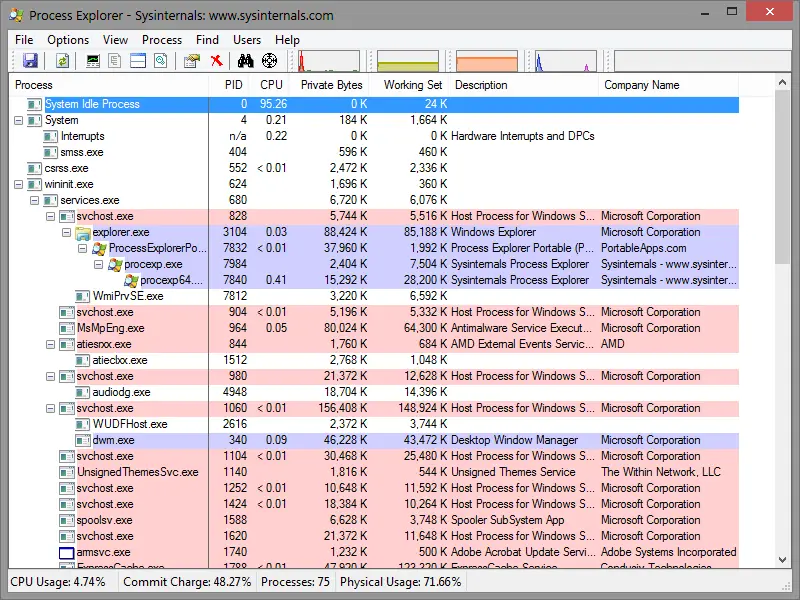
The tool also features a powerful search capability that will quickly evidence you which processes accept particular handles opened or DLLs loaded. This will allow us to use it to hands ready most unwanted file locks in a matter of seconds: we just take to search for the locked file, retrieve the process which is keeping the handle and close (or kill) it accordingly.
Solution #three (dandy): Handle
SolutionExplorer is a smashing assay tool, yet it lacks some useful options to actually gear up our specific issue: altough we can use it to kill a whole process, it doesn't provide a manner to release a specific handle: whenever we're dealing with files locked by processes we cannot kill, such every bit Arrangement, this can be a problem. In guild to achieve such surgical result nosotros need to go our easily to some other great Sysinternals utility that goes by the proper noun of Handle .
Handle is basically the console version of ProcessExplorer: recall of information technology similar a ProcessExplorer with command-line options instead of the GUI. This could make it less intuitive when we demand to investigate our organisation, yet information technology has extremely powerful tools when information technology comes to ready the problems we establish.
The most mutual usage of Handle - for our specific scenario - is the following:
- Download Handle and unzip information technology into a folder of your pick.
- Open a command prompt window with administrative priviledges and input the post-obit control:
Handle64.exe > output.txt . The tool will then create a list of active processes/handles and write the (huge) outcome into the output.txt file. - Do not close the command prompt , equally you volition need it over again. Open the output.txt file with your favourite text editor and search for a row containing your locked file name. Once y'all observe it, look for the HEX number to the left and write it downward: this is the ID of thehandle you need to close. Correct after that, go upwardly through the file until y'all accomplish the parent row, which contains the informations almost the process which is holding that handle. Again, look for the modest HEX number to the left and write information technology down: this is the ID of the process yous'll demand to utilise in the following step. As a side note: Organisation procedure ID is commonly four, although it could vary in the time to come.
- Get back to the control prompt and try to close the handle by typing the following:
handle.exe -c <handleID> -p <processID> , replacing the placeholders with the values you found in the previous pace.
If everything goes correctly, you will prepare your problem without killing the procedure and - more importantly - without having to reboot the system.
That's it for at present: happy "handling"!
Source: https://www.ryadel.com/en/unlock-file-handle-locked-system-active-process-windows/
0 Response to "This File Is Locked Try the Command Again Later Excel 2010"
Post a Comment